
If you run a web design or development shop and you’ve never bid on government work, 2026 is the year to start paying attention. A federal accessibility rule has quietly turned into one of the largest waves of public-sector website spending in years and most of it is being procured through RFPs posted on procurement portals that most agencies never look at.
Here’s what’s driving the surge, who’s buying, what the solicitations actually ask for, and how to catch them while the window is open.
What the DOJ’s ADA Title II Rule Requires
In April 2024, the Department of Justice published a final rule under Title II of the Americans with Disabilities Act (28 CFR Part 35) that, for the first time, sets a specific technical standard for state and local government websites and mobile apps: WCAG 2.1 Level AA.
In practice, that means every public-facing digital property a government operates the main website, the parks reservation system, the utility billing portal, the transit app, the PDFs of meeting agendas must meet a detailed accessibility standard covering things like keyboard navigation, screen-reader compatibility, color contrast, captions on video, properly labeled forms, and accessible documents.
The rule allows five narrow exceptions: archived web content; preexisting conventional electronic documents (PDF, Word, Excel, PowerPoint files) unless they’re currently used to apply for, access, or participate in a government service; content posted by third parties the government doesn’t control or contract for; individualized documents that are password-protected; and preexisting social media posts. Outside those, the default is simple: if the public uses it, it must conform.
And one detail contractors consistently miss: the rule also covers web content and apps provided by entities operating on a government’s behalf. The sites, portals, and applications you build or run for a public-sector client must themselves meet WCAG 2.1 AA. Accessibility competence isn’t just a scoring criterion on these bids — it’s a legal requirement of delivering the work.
This isn’t guidance. It’s a regulation with fixed deadlines — and missing them exposes an entity to DOJ enforcement and private lawsuits, which is precisely why budget lines that didn’t exist two years ago are now turning into solicitations.
Who Must Comply and by When
The rule applies to every Title II entity: states, cities, counties, towns, and their departments plus public schools and school districts, community colleges and public universities, public libraries, transit agencies, water and utility districts, housing authorities, and other special-purpose districts.
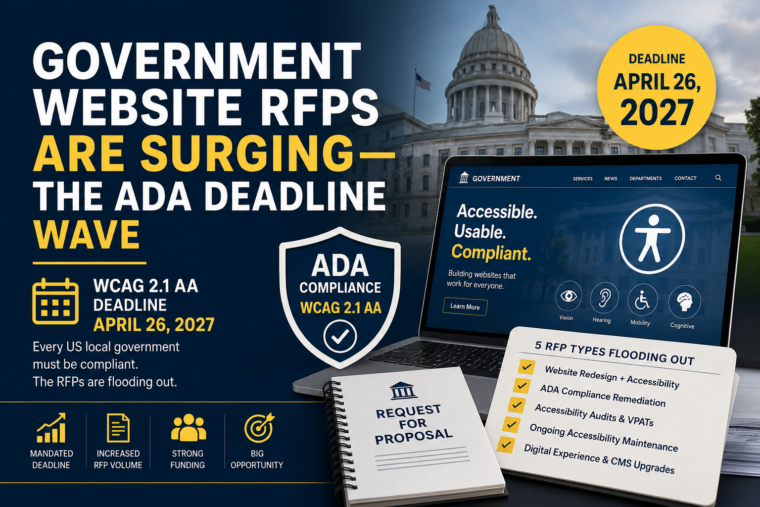
And the deadline is uniform. Per DOJ’s published compliance dates, every covered entity must comply by April 26, 2027, a state government, a city of two million, a town of two thousand, and a rural water district are all working toward the same date.
Do the math on that. The United States has roughly 90,000 units of local government, and the overwhelming majority — small towns, rural counties, school districts, library systems, water authorities have small or nonexistent internal web teams. They cannot do this work themselves. They have to buy it. And they’re all buying against the same clock.
That convergence is what makes 2026 the surge year. Accessibility work takes months end to end, audit, budget approval, procurement, redesign or remediation, testing, so an April 2027 compliance date means solicitations have to go out now. Entities that wait until early 2027 to issue their RFPs will be competing for vendor capacity that’s already booked.
In this equation, qualified vendors are the scarce resource, which is a very good position for a prepared web shop to be in.
The Five RFP Types the Rule Is Creating
1. Full website redesigns. The most common response for older sites: rebuilding on an accessible platform is cheaper than patching a decade of accumulated problems. These RFPs pair accessibility with modernization, responsive design, better search, online services, and typically run five to six figures.
2. Accessibility audits and WCAG conformance assessments. Smaller, faster engagements where an entity needs to know how bad things are before budgeting the fix. Often the foot in the door: the auditor is well positioned for the remediation contract that follows.
3. Remediation services. Fixing an existing site to conformance without a rebuild, templates, navigation, contrast, forms, media. Frequently scoped as time-and-materials or fixed-fee sprints.
4. Document remediation. The sleeper category. Governments publish enormous volumes of PDFs including agendas, minutes, forms, reports, and the rule reaches them. Dedicated document-remediation solicitations are appearing, and they suit smaller shops and specialists.
5. Ongoing monitoring, testing, and training. Conformance isn’t a one-time event; sites change weekly. Entities are procuring monitoring services, periodic re-audits, and staff training, recurring-revenue contracts that outlast the deadline itself.
One pattern across all five: evaluation criteria increasingly ask for demonstrated WCAG expertise, examples of accessible public-sector work, and sometimes a VPAT or a named certified accessibility professional (CPACC/WAS) on the team. If you have any of that, say so prominently, many bidders don’t.
Where These RFPs Are Posted and Why Most Shops Never See Them
Here’s the catch. These solicitations don’t appear in one place. They’re scattered across state procurement portals, county and city purchasing pages, cooperative purchasing sites, and school district and special-district portals, hundreds of separate systems, each with its own registration, categories, and search quirks. A small town’s website redesign RFP might live only on a state portal and its own purchasing page, visible for three or four weeks before the deadline closes.
Manually checking even a dozen portals daily isn’t realistic for a working agency. That’s the problem an RFP database solves: aggregating solicitations from hundreds of portals into a single searchable feed, filtered to the categories you actually serve.
How to Catch ADA Website RFPs Before the Wave Peaks
A workable daily system takes about ten minutes: set alerts for the terms these solicitations actually use “website redesign,” “ADA compliance,” “WCAG,” “accessibility audit,” “remediation” review the day’s matches, and qualify fast against three questions: Is the scope within our capability? Is the timeline sane? Is there budget signal (attached budget, prior contract, or funded mandate and an ADA deadline is the strongest funding signal there is)?
The Bid Daily curates technology RFPs including website design, redesign, and accessibility work from portals nationwide into one daily email, so the morning check replaces the portal crawl. Between now and April 2027, web design is likely to stay the busiest category in the feed.
The Window Is Open – For Now
Every procurement wave has a shape: early solicitations get fewer, better bids; late ones get crowded and rushed. Right now, thousands of small governments are budgeting for work they legally must complete within nine months, and the agencies winning those contracts are simply the ones who saw the RFP in time.
Want the website and accessibility RFPs to come to you? Subscribe to The Bid Daily and get every new web design RFP, curated daily, in your inbox each morning.
FAQ
Q: What is the deadline for ADA website compliance for local governments?
A: April 24, 2026 for public entities with populations of 50,000 or more; April 26, 2027 for entities under 50,000 and all special district governments.
Q: What standard do government websites have to meet?
A: WCAG 2.1 Level AA, under the DOJ’s 2024 rule implementing Title II of the ADA (28 CFR Part 35).
Q: Where can I find government website design RFPs?
A: They’re posted across hundreds of state and local procurement portals; an RFP database like The Bid Daily aggregates and curates them into a single daily feed.