
If you run a web design or development shop, you have probably wondered whether a free RFP database is enough to keep your pipeline full, or whether it is worth paying for one. It is a fair question. Chasing new projects takes time you would rather spend building sites, and every dollar counts when you are a small team. The good news is that both free and paid options can work well. The trick is understanding what each actually gives you, so you can match the tool to how you win business.
Below is an honest, plain-English breakdown of what a free tier typically covers, what paid access unlocks, and how to decide which one earns its place in your workflow.
What a Free Database Actually Covers
A free RFP database is a great place to start, especially if you are new to bidding or just testing whether public-sector and nonprofit work is a good fit for your agency. Free tiers usually give you a real, usable slice of the market without asking for a credit card.
Here is what you can generally expect at no cost:
- Browse access to open opportunities. You can search and read active listings, see the organization behind each one, and get a feel for the kinds of projects being posted.
- A sense of the categories. Free access lets you scan whether the work skews toward small nonprofit refreshes, municipal redesigns, or larger builds, so you can judge fit before you commit.
- Basic filtering. Most free tiers let you narrow by keyword or category, so you are not scrolling endlessly.
- A low-risk way to learn the ropes. Reading real RFPs teaches you how buyers describe scope, budget, and timelines, which makes your first proposals sharper.
For a lot of agencies, that is genuinely enough to get moving. If you only need a handful of good-fit projects a quarter and you do not mind checking in manually, a free tier can carry you a long way.
What Paid Access Unlocks
Paid tiers are built for agencies that treat bidding as a real channel, not an occasional experiment. When you are responding to several RFPs a month, small conveniences add up to hours saved and deadlines caught. Paid access to a bid database typically layers on the features that make consistent bidding practical.
Broader coverage, including government RFPs: The biggest reason agencies upgrade is coverage. A paid tier often opens up US government RFPs at the federal, state, and local levels, along with more categories and a deeper archive. Government and public-sector web projects tend to have real budgets and clear scopes, and there are more of them than most agencies realize. Getting reliable access to that supply is often worth the modest cost on its own.
Alerts so you stop missing deadlines: Free browsing works until the day you check back and find a perfect-fit RFP that closed last week. Paid tiers usually include alerts or saved searches that email you when something matching your criteria gets posted. That turns bidding from a chore you have to remember into a quiet stream that comes to you.
Better filtering and time savings: When you are looking at a larger volume of opportunities, sharper filters matter. Paid access generally lets you slice by location, budget signals, agency type, and technology, so you spend your time reading the five RFPs worth pursuing instead of skimming fifty that are not.
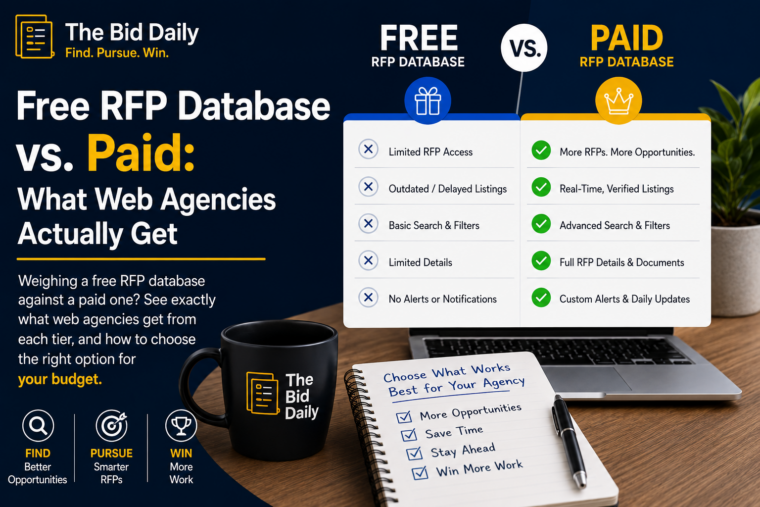
Comparing a Free vs. a Paid Bid Database
It helps to line the two up side by side. Neither is objectively better; they serve different stages of an agency’s growth.
- Cost: Free is, well, free. A paid RFP database is usually a small monthly fee, which for many agencies is less than the cost of a single lost hour hunting for leads.
- Coverage: Free tiers give you a meaningful sample. Paid tiers add depth, more categories, and government bids you will not easily find elsewhere.
- Convenience: Free means you check manually. Paid means alerts and saved searches do the checking for you.
- Best for: Free suits newcomers and occasional bidders. Paid suits agencies making bidding a repeatable part of how they grow.
As a real-world example, The Bid Daily offers a free digital tier so you can browse opportunities and learn how the platform works, plus a paid tier for around five dollars a month that opens up US government bids. That kind of pricing makes the decision less about money and more about whether you are ready to bid regularly.
How to Decide Which One Is Right for You
You do not need to overthink this. A few honest questions will point you in the right direction.
How often do you actually bid? If you respond to one or two RFPs a quarter, start free. If you are aiming to submit several proposals a month, the time saved by alerts and broader coverage usually pays for a paid tier many times over.
Do you want government and public-sector work? Government website projects are a steady, budget-backed source of work, but they are spread across countless portals. If that market is where you want to grow, paid access that consolidates those bids is the shortcut. You can always begin by exploring a free RFP database to see whether the opportunities match your skills before you upgrade.
What is your time worth? The honest math is simple. If checking for new RFPs manually eats a couple of hours a week, and a paid tier costs less than one hour of your billable rate, the upgrade often frees up time you can put back into billable work or better proposals.
A Sensible Path Forward
For most agencies, the smartest approach is to start free and upgrade when the pattern is clear. Spend a few weeks browsing, submit a proposal or two, and pay attention to where the good-fit work is coming from. If you find yourself wishing you had been notified sooner, or wanting access to the government bids sitting just out of reach, that is your signal to move to a paid plan.
There is no wrong first step here. A free tier costs you nothing but a little manual effort, and a paid tier costs little while saving you real time. Either way, the goal is the same: fewer hours hunting for work and more hours doing the work you are good at. Try the free option first, get comfortable with how bidding fits your agency, and let your own results tell you when it is time to invest a bit more.