
RFP Database Explained: How to Find & Win More Contracts
Every year, US government agencies, school districts, universities, and private companies publish hundreds of thousands of Requests for Proposal, a formal invitation for vendors to bid on real, funded work. An RFP database is the tool that brings those scattered opportunities into one searchable place, so you spend your time writing winning proposals instead of hunting for them. This guide explains what an RFP database is, where RFPs actually come from, how aggregation and curation work under the hood, and how to choose the right option for your business, including when the free ones are all you need.
What Is an RFP Database?
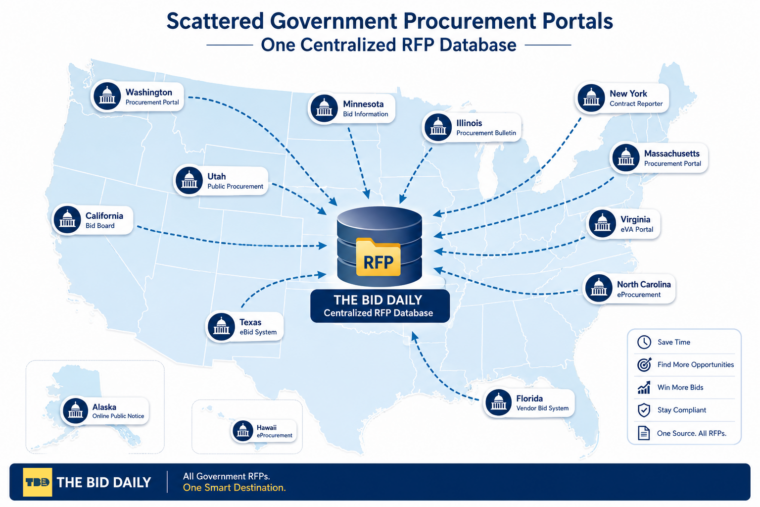
An RFP database is a continuously updated, searchable collection of RFPs, RFQs, and bid notices gathered from many different sources including federal portals, state procurement sites, city and county purchasing pages, school districts, universities, and sometimes private companies. Instead of registering on dozens of individual portals and checking each one, you search a single feed, filter by industry and location, and receive alerts when something matches.
That’s the whole idea, and it sounds almost too simple. The reason it matters becomes obvious once you understand just how fragmented the RFP landscape really is.
Why Finding RFPs Manually Doesn’t Scale
The United States doesn’t have one government, it has roughly 90,000 of them: federal agencies, 50 states, and tens of thousands of counties, cities, towns, school districts, transit authorities, housing authorities, and water districts. Nearly all of them buy technology, websites, software, and marketing services. Nearly all of them buy independently.
In practice, that means:
- Federal opportunities live on SAM.gov, but only contracts above certain dollar thresholds, and only federal ones.
- Each state runs its own portal. New York’s Contract Reporter, Cal eProcure, Texas’s ESBD, and 47 more, each with its own registration, categories, and notification quirks.
- Cities, counties, and school districts are scattered across commercial eProcurement platforms including Bonfire, OpenGov, Periscope ePro, BidNet Direct’s regional networks and thousands of them still post opportunities as PDFs on a plain “Bids & RFPs” webpage that no alert system will ever tell you about.
Suppose you’re a web design studio willing to work with any public agency in five states. Realistic coverage means monitoring 40–60 portals. At even five minutes per portal, that’s 4–5 hours a week of pure checking before you’ve read a single RFP. And timing is unforgiving: most RFPs allow two to four weeks to respond. Find one on day 12 of a 21-day window and you’re writing a rushed proposal against competitors who’ve known about it, and possibly talked to the agency since day one.
Where RFPs Actually Come From
Understanding the sources helps you judge any database’s coverage claims — including The Bid Daily.
- Federal (SAM.gov). The single largest source by dollar value. Free to search, authoritative, but federal-only, and much federal IT spending flows through pre-negotiated contract vehicles (GWACs, IDIQs) that never appear as open RFPs at all.
- State portals. Every state publishes bids for state agencies; some (like New York) also carry local-government notices. Quality and searchability vary enormously.
- Local government. Cities, counties, and special districts – the richest and least-watched vein for web design, branding, app development, and small-to-mid IT projects. A county website redesign might attract 4–6 bidders; a comparable federal contract can attract 40.
- Education. K-12 districts and universities issue steady streams of technology and creative RFPs, often through their own portals or regional purchasing cooperatives.
- Private sector and nonprofits. Companies and foundations do issue RFPs through social media, their website or sent by invitation to a shortlist rather than published. Not every database capture those; they often come from relationships.
- The SME takeaway: open, published RFPs skew heavily toward the public sector, and the best-kept secret in the market is how uncompetitive many local opportunities are. The barrier is never eligibility, it’s simply that most firms never see them in time.
How an RFP Database Works Under the Hood
A good database does four jobs, in order:
- Aggregation. Monitoring hundreds of portals daily, pulling from official data feeds where they exist and systematically checking published listings where they don’t. Coverage breadth is the first thing that separates services.
- Normalization. Every portal formats things differently. The database deduplicates cross-posted notices and standardizes the fields that matter: due date, issuing agency, location, and category.
- Filtering and curation. This is where services diverge most. Raw aggregators hand you everything, including asphalt paving and janitorial contracts, and leave the filtering to you. Keyword filters help but misfire (a filter for “IT” will happily match “audit”). Curated services apply category expertise so that what reaches you is actually in your lane.
- Alerts. The end product isn’t really a database – it’s time. A daily email digest that surfaces matching opportunities the morning they appear converts hours of portal-checking into a two-minute inbox scan, and gets you into the response window on day one instead of day twelve.
At The Bid Daily, we run this pipeline exclusively for technology and digital services – software, IT services, web design and development, graphic design, branding, and digital marketing. Because we don’t try to cover every industry, every opportunity in the feed is one a tech or digital firm could plausibly bid on.
The Three Kinds of RFP Databases (and Who Each Is For)
- Free government portals. SAM.gov, your state’s procurement site, and your target cities’ bid pages. Cost: $0. Authoritative and complete for their own scope. The trade-off is assembly: you become your own aggregator, maintaining registrations and checking routines across every portal you care about. Right choice if you bid federal-only, or in one state you know well.
- Broad aggregators. Services like BidNet Direct, FindRFP, and GovSpend cover thousands of agencies across all industries. Enormous reach; the trade-offs are noise (you filter out the 95% that isn’t your industry) and, at the enterprise end, four-figure annual pricing. Right choice for firms bidding across many industries or needing spending analytics.
- Niche curated services. Focused feeds – The Bid Daily for technology and digital work, that trade total breadth for near-zero noise and a price an independent studio can justify. Right choice if you sell digital services and want relevant opportunities delivered rather than discovered.
An honest note: these aren’t mutually exclusive. Plenty of our subscribers also watch SAM.gov directly for large federal work. Use free portals for depth in your home market; use a curated feed for breadth everywhere else.
How to Choose? Five Questions That Actually Matter
- Coverage: Does it include state and local opportunities, or just federal? Local is where the winnable contracts hide.
- Freshness: Are new RFPs added daily? A weekly digest can cost you a third of a response window.
- Signal-to-noise: Will you see 10 relevant opportunities or 400 mixed ones? Your triage time is a real cost.
- Delivery: Does it come to you (email alerts), or do you still have to remember to log in?
- Price vs. one contract: The math is blunt. A subscription at $20–50/month costs $240–600 a year; a single mid-sized municipal website contract runs $15,000–75,000. If a database surfaces even one contract you’d otherwise have missed, it has paid for itself many times over.
From Finding RFPs to Winning Them
A database solves discovery. Winning is a separate discipline – here’s what consistently separates firms that convert:
- Bid fewer, better-fit RFPs. Qualify hard: Is there an incumbent? Is a budget stated? Is the timeline realistic, or does a two-week window on a complex scope suggest the outcome is already decided? A focused firm winning 1 in 4 well-chosen bids beats a scattershot firm winning 1 in 20.
- Move on day one. Early movers can submit clarifying questions during the Q&A period – sometimes shaping the requirements, and get every addendum with time to react.
- Register on the issuing portal immediately after finding an RFP anywhere, so you receive amendments and Q&A responses directly. Missing an addendum is a common disqualifier.
- Build a proposal library. Reusable past-performance write-ups, bios, and approach sections cut response time from days to hours, which is what makes a steady bid cadence sustainable.
- Track your numbers. Bids submitted, shortlists, wins, and revenue per bid hour. The data will tell you which agencies and contract sizes to double down on.
Stop hunting. Start bidding.
The Bid Daily monitors government, public, non-profits, and private RFP sources across the US every day and delivers the technology, web, design, and digital marketing opportunities to your inbox each morning.
Subscribe to The Bid Daily and see today’s open RFPs
Frequently Asked Questions
What is an RFP database? A searchable, regularly updated collection of Requests for Proposal aggregated from many government and private sources, usually with filtering and email alerts, so vendors can find bidding opportunities without monitoring each source individually.
Are there free RFP databases? Yes. SAM.gov (federal) and every state procurement portal are free, and many cities publish bids openly. Free sources are authoritative but siloed, you assemble and maintain the coverage yourself.
What’s the difference between SAM.gov and an RFP database? SAM.gov is the official source for federal opportunities only. An RFP database aggregates many sources including federal, state, local, education, and sometimes private, into one feed.
How much does an RFP database cost? Free (government portals) to thousands per year (enterprise aggregators). Niche curated services like The Bid Daily sit in between, priced for small firms and independent contractors.
Do RFP databases include private-sector RFPs? Some published private and nonprofit RFPs, yes, but many private RFPs are invitation-only and never published anywhere. Public-sector coverage is where databases add the most value.
How often are new RFPs added? Good services update daily. The Bid Daily reviews new opportunities every business day and sends matching ones in a morning email.