If you have tried chasing government web design RFPs, you already know the frustration. The work is real, the budgets are solid, and the projects keep coming, but the opportunities are scattered across a dizzying number of websites. Federal has its own system. Every state runs a portal. Then there are counties, cities, school districts, and special agencies, each posting bids wherever they please. Checking them all by hand is exhausting, and it is the single biggest reason talented agencies give up on public-sector work before they ever win a contract.
It does not have to be that way. This guide walks through where government website projects actually live, why portal-hopping fails, and how a simple two-minute daily habit can replace the whole grind.
Why Government Web Design RFPs Are Worth the Effort
Before the how, a quick word on the why. Public-sector website work is some of the most stable and rewarding an agency can win. Government bodies at every level are under real pressure to modernize their sites, improve accessibility, and deliver services online. That means a steady flow of redesigns, new builds, and ongoing maintenance contracts.
Compared to chasing small commercial projects, government web design RFPs tend to offer:
- Defined budgets. Public agencies plan and fund projects in advance, so the money is usually real.
- Clear scope. Solicitations spell out requirements in detail, which makes proposals easier to write and projects easier to price.
- Repeat opportunity. Win one municipal site and you build past performance that helps you win the next.
- Less price-only competition. Evaluations weigh experience and approach, not just the lowest bid, which rewards quality work.
The Problem: Fifty Portals and Counting
The catch is distribution. There is no single front door for government website bids. Federal solicitations run through a central system. State work lives on state procurement portals, each with its own registration, login, and search quirks. Below that, thousands of counties, cities, towns, school districts, libraries, and transit and utility authorities publish where they like, some on polished portals, many on a plain “bids and RFPs” page buried three clicks deep on a municipal site.
For an agency, that fragmentation creates three practical problems. You miss opportunities simply because you never saw them. You waste hours each week logging into portals and repeating the same searches. And you routinely find the perfect project three days before it closes, with no realistic chance to prepare a strong proposal. None of that reflects your ability to do the work, it is purely a sourcing problem.
Where Government Website Projects Actually Live
To find government web design RFPs on your own, these are the layers worth knowing:
- Federal: most federal opportunities are posted centrally, and larger agencies also run their own vendor pages. Federal work tends to be bigger and more competitive, with heavier compliance requirements.
- State: nearly every state runs a procurement portal that lists executive-agency and often higher-education solicitations. Registering is usually free but required to download documents or submit.
- Local: this is where the volume is. City, county, and town websites host the majority of website redesign and development bids, and they are the hardest to monitor because there are so many of them.
- Education & special districts: school districts, universities, libraries, and authorities are steady sources of website work and frequently fly under the radar of agencies that only watch state portals.
Knowing the map helps, but it also makes the core problem obvious: no person can realistically check all of these every day. That is exactly why a smarter approach beats brute force.
Why Portal-Hopping Fails (and What Works Instead)
Manually monitoring government website bids breaks down for a simple reason: effort scales with the number of sources, and the number of sources is enormous. Even a disciplined agency that checks a handful of state RFP portals every morning is still blind to the hundreds of local pages where most public sector web projects appear.
The approach that actually works is to stop visiting sources one by one and instead pull them into a single, filtered feed. When every relevant solicitation, federal, state, local, and institutional lands in one searchable place, the daily grind of portal-hopping collapses into a quick scan. You spend your time evaluating opportunities and writing proposals, not hunting for links.
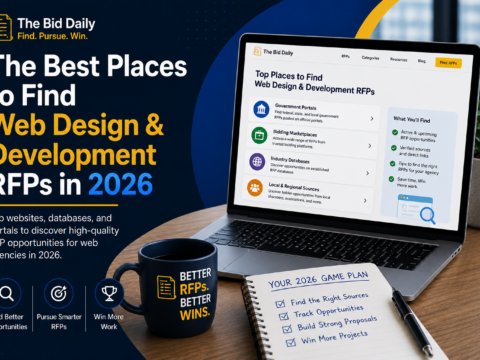
That is the whole idea behind The Bid Daily: it aggregates technology and web design solicitations from hundreds of sources across all fifty states and files them under the categories agencies actually bid on, so a two-minute morning scan replaces an hour of portal checking.
Building a Two-Minute Daily Habit
However you choose to source them, the goal is to turn discovery into a light, repeatable routine instead of a weekly slog. A few habits make government web design RFPs far easier to stay on top of:
- Search by fit, not just keyword. Filter for web design, development, and digital services, and layer in your geography and budget range so you only see projects worth pursuing.
- Set alerts. A notification the day a matching bid is posted is worth more than finding it a week later, because it gives you time to write a real proposal.
- Track deadlines early. Log the due date and any pre-bid meeting the moment you spot an opportunity, so nothing slips.
- Make bid/no-bid decisions fast. A steady flow of relevant opportunities lets you pass on poor fits and pour your energy into the ones you can win.
Do this consistently and public-sector work stops feeling like luck. You see more government website bids, you see them earlier, and you build the track record that makes each new proposal stronger.
Stop Hunting, Start Bidding
Government web design RFPs are among the best opportunities an agency can pursue, funded, well-scoped, and repeatable. The only thing standing between most agencies and that work is discovery, and discovery is a solved problem the moment you stop checking fifty portals and start working from one feed. Pick a sourcing routine you can keep, set a couple of alerts, and give your next public-sector proposal the runway it deserves.